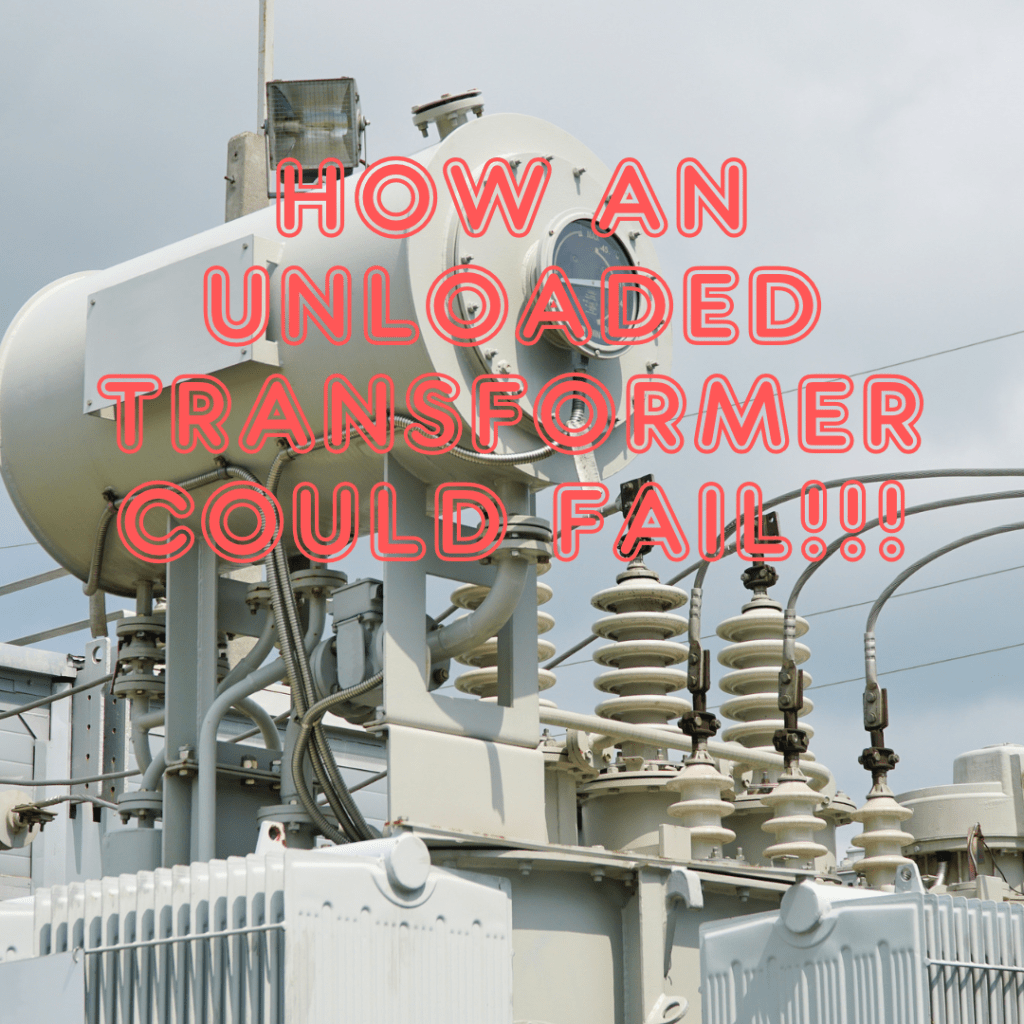
Let’s discuss why an unloaded transformer can fail. Also discuss how to minimize the risk.

An unloaded transformer refers to a transformer that is not connected to any load or consuming any power. While transformers are designed to operate with a load, they can still experience failures or issues when unloaded. Here are some reasons why an unloaded transformer can fail and steps to minimize the associated risks:
- Overvoltage: When a transformer is unloaded, it can experience overvoltage conditions. This occurs because the transformer’s primary winding still receives the same voltage from the source, but without a load, the secondary winding does not consume the energy. As a result, the transformer may experience a higher voltage than its design limits, leading to insulation breakdown and failure. To minimize the risk of overvoltage, it’s important to ensure that transformers are always connected to an appropriate load.
- Saturation: Transformers rely on magnetic fields to transfer energy from the primary winding to the secondary winding. When an unloaded transformer operates with no load, the magnetic flux may not be dissipated effectively. This can lead to magnetic saturation, where the core of the transformer becomes saturated with magnetic energy. Saturation can cause increased losses, overheating, and potential damage to the transformer. To minimize the risk of saturation, transformers should always be connected to a load within their specified ratings.
- Resonance: An unloaded transformer can experience resonant conditions, especially in high-frequency applications. Resonance occurs when the transformer’s inductance and capacitance form a natural frequency, resulting in excessive voltage or current amplification. This can lead to insulation breakdown, arcing, or even catastrophic failure. To avoid resonance, transformers should be properly designed, taking into account the system’s operating frequency and impedance characteristics.
- Ferroresonance: Ferroresonance is a special case of resonance that can occur in unloaded transformers. It happens when there is a combination of non-linear magnetic properties in the transformer core, capacitance in the system, and voltage excitation. Ferroresonance can cause severe overvoltages, leading to insulation failure, core damage, and even explosions. To minimize the risk of ferroresonance, proper transformer design and system grounding techniques should be employed.
To summarize, an unloaded transformer can fail due to overvoltage, saturation, resonance, or ferroresonance. To minimize the associated risks, transformers should always be connected to an appropriate load within their specified ratings. Adequate system design, including proper grounding and consideration of operating frequencies, is essential to ensure the safe and reliable operation of transformers.
when unloaded. Here are some reasons why an unloaded transformer can fail and steps to minimize the associated risks:
- Overvoltage: When a transformer is unloaded, it can experience overvoltage conditions. This occurs because the transformer’s primary winding still receives the same voltage from the source, but without a load, the secondary winding does not consume the energy. As a result, the transformer may experience a higher voltage than its design limits, leading to insulation breakdown and failure. To minimize the risk of overvoltage, it’s important to ensure that transformers are always connected to an appropriate load.
- Saturation: Transformers rely on magnetic fields to transfer energy from the primary winding to the secondary winding. When an unloaded transformer operates with no load, the magnetic flux may not be dissipated effectively. This can lead to magnetic saturation, where the core of the transformer becomes saturated with magnetic energy. Saturation can cause increased losses, overheating, and potential damage to the transformer. To minimize the risk of saturation, transformers should always be connected to a load within their specified ratings.
- Resonance: An unloaded transformer can experience resonant conditions, especially in high-frequency applications. Resonance occurs when the transformer’s inductance and capacitance form a natural frequency, resulting in excessive voltage or current amplification. This can lead to insulation breakdown, arcing, or even catastrophic failure. To avoid resonance, transformers should be properly designed, taking into account the system’s operating frequency and impedance characteristics.
- Ferroresonance: Ferroresonance is a special case of resonance that can occur in unloaded transformers. It happens when there is a combination of non-linear magnetic properties in the transformer core, capacitance in the system, and voltage excitation. Ferroresonance can cause severe overvoltages, leading to insulation failure, core damage, and even explosions. To minimize the risk of ferroresonance, proper transformer design and system grounding techniques should be employed.
To summarize, an unloaded transformer can fail due to overvoltage, saturation, resonance, or ferroresonance. To minimize the associated risks, transformers should always be connected to an appropriate load within their specified ratings. Adequate system design, including proper grounding and consideration of operating frequencies, is essential to ensure the safe and reliable operation of transformers.
 Energy Risk Engineering Insights